In the high-pressure food and beverage industry, idle production lines represent significant revenue loss and operational disruption. While many facility managers view long changeover times as a necessary evil, industry leaders treat them as critical opportunities for optimization.
Adopting a pit-stop mentality allows your team to transform these operational pauses into a competitive advantage through precision and speed. Keep reading for tips on how to streamline changeovers for your food and beverage line.
Understanding Your Current Process
You cannot improve what you do not fully understand. Before implementing new protocols, you must dissect your current changeover routine. This involves observing a changeover from start to finish and documenting every action taken by the operators and maintenance staff. You will likely discover that a significant portion of the downtime comes from searching for tools, waiting for materials, or making fine-tuning adjustments after restarting the machine.
Mapping the process allows you to distinguish between internal and external setup tasks. Internal tasks are those that can only happen after stopping the machine, such as changing a forming tube or a seal jaw. External tasks are those you can perform while the machine is still running the previous job, such as retrieving the next roll of film or gathering the necessary tools. The goal of this mapping exercise is to convert as many internal tasks as possible to external tasks. When you identify these bottlenecks, you create a roadmap to reduce downtime and increase overall equipment effectiveness (OEE).
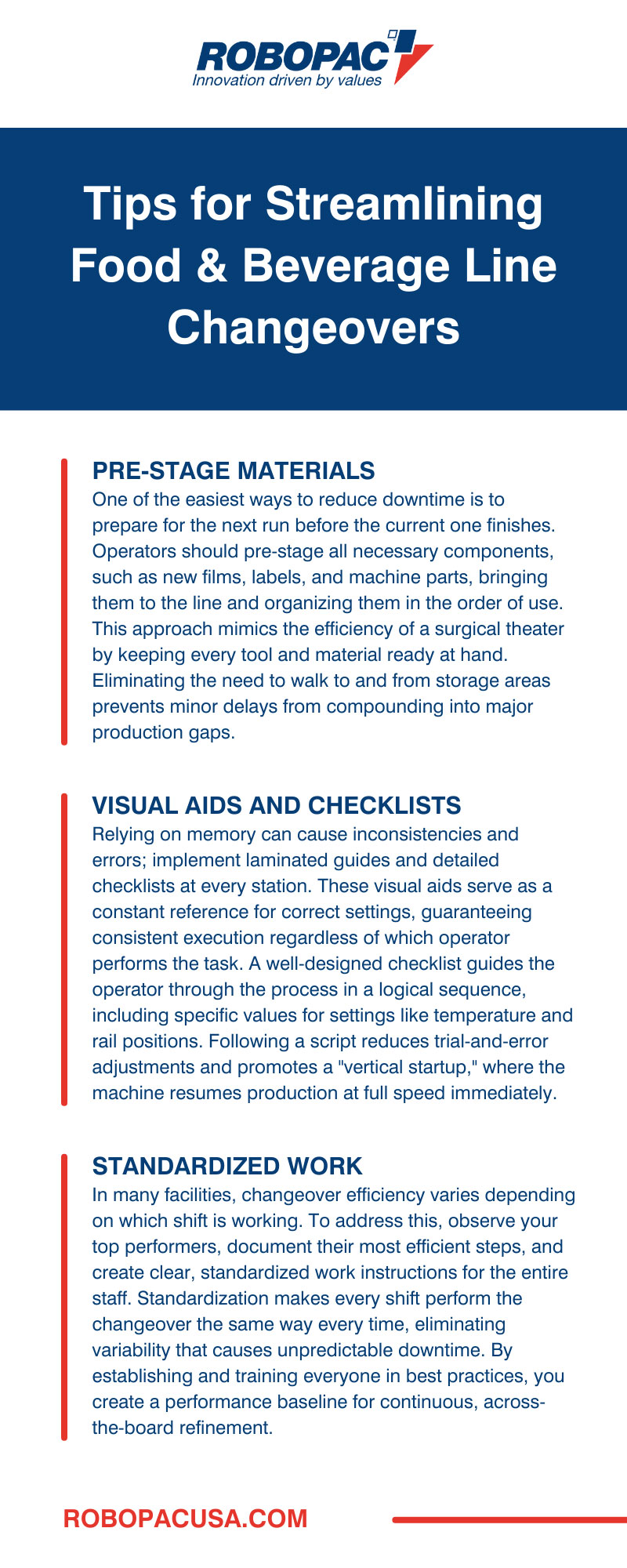
Pre-Stage Materials
One of the easiest ways to reduce downtime is to prepare for the next run before the current one finishes. Operators should pre-stage all necessary components, such as new films, labels, and machine parts, bringing them to the line and organizing them in the order of use. This approach mimics the efficiency of a surgical theater by keeping every tool and material ready at hand. Eliminating the need to walk to and from storage areas prevents minor delays from compounding into major production gaps.
Visual Aids and Checklists
Relying on memory can cause inconsistencies and errors; implement laminated guides and detailed checklists at every station. These visual aids serve as a constant reference for correct settings, guaranteeing consistent execution regardless of which operator performs the task. A well-designed checklist guides the operator through the process in a logical sequence, including specific values for settings like temperature and rail positions. Following a script reduces trial-and-error adjustments and promotes a “vertical startup,” where the machine resumes production at full speed immediately.
Standardized Work
In many facilities, changeover efficiency varies depending on which shift is working. To address this, observe your top performers, document their most efficient steps, and create clear, standardized work instructions for the entire staff. Standardization makes every shift perform the changeover the same way every time, eliminating variability that causes unpredictable downtime. By establishing and training everyone in best practices, you create a performance baseline for continuous, across-the-board refinement.
Quick-Release Mechanisms
Another tip for streamlining food and beverage line changeovers is to optimize your machines and equipment with quick-release mechanisms. If your operators need tools to loosen bolts and adjust guide rails, you are losing valuable time. Modernize your equipment by installing quick-release mechanisms such as snap-on parts, hand-turn knobs, or quick-clamps. This concept, known as “tool-less changeover,” allows operators to swap components without reaching for a toolbox, significantly reducing effort and time. By engineering tools out of the process, you simplify the task and allow operators to focus on precision.
Digital Recipe Management
Manual data entry is slow and prone to human error, which can waste entire batches of product. Eliminate this risk by using the human-machine interface (HMI) to store product-specific settings as digital “recipes.” When switching products, the operator selects the correct recipe, and the machine automatically recalls the precise parameters for that job. This instant recall provides 100 percent accuracy for settings like temperatures and speeds, removing guesswork and reliance on memory.
Automation
Manual adjustments with handwheels and cranks are tedious and difficult to repeat with perfect accuracy. Instead, invest in automated food packaging machines with sensors and servo drives to automatically adjust conveyor widths, rail heights, and timing. Automation speeds up the physical transition and guarantees repeatability, as a servo motor moves to the same position every time. This precision reduces the need for fine-tuning after startup, allowing you to reach production speed faster.
Cross-Train Operators
If only one person knows how to perform a critical changeover step, that person becomes a bottleneck, and their absence can halt the entire line. Prevent this single point of failure by cross-training operators on multiple stations and tasks. A flexible workforce allows multiple operators to work in parallel, drastically reducing total changeover time. Cross-training also fosters a deeper understanding of the entire process, enabling better coordination and minimizing downtime.
Operator Involvement
Your machine operators possess firsthand knowledge of daily bottlenecks and equipment frustrations, making them essential to process improvement. Excluding floor personnel from these discussions is a significant oversight that risks overlooking practical solutions management might otherwise identify. Actively soliciting feedback fosters a culture of ownership where employees take pride in the efficiency of their production line. This collaborative approach leads to sustainable operational improvements because the team executing the work has a direct stake in the process design.
Map the Process
Continuous improvement necessitates an ongoing, step-by-step analysis of your workflow to identify new optimization opportunities. By regularly mapping the changeover process, you can determine which tasks currently stopping the line workers could perform offline instead. These mapping exercises must be frequent, as introducing new products or automation equipment will naturally cause the optimal process to evolve. Maintaining updated standard operating procedures allows your team to focus on minimizing downtime through a consistent “pit stop” mentality.
Data and Monitoring
Accurate decision-making in warehouse automation requires the use of sensors and data analysis tools to track performance parameters. Key metrics, such as the time from the “last good part” to the “first good part,” provide a true measure of changeover efficiency. Consistent monitoring also highlights discrepancies when specific products run slower than designed speeds after a transition. This data-driven visibility enables maintenance teams to quickly identify root causes, confirming that your equipment delivers the expected throughput without compromising quality.
Advancing Your Line Performance
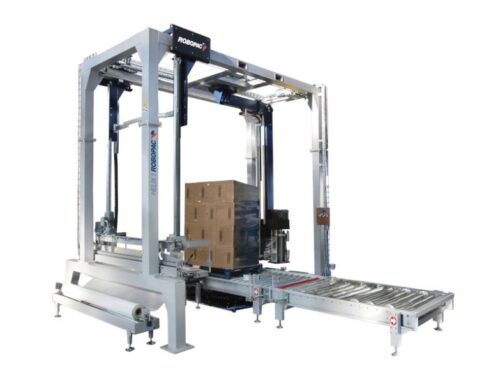
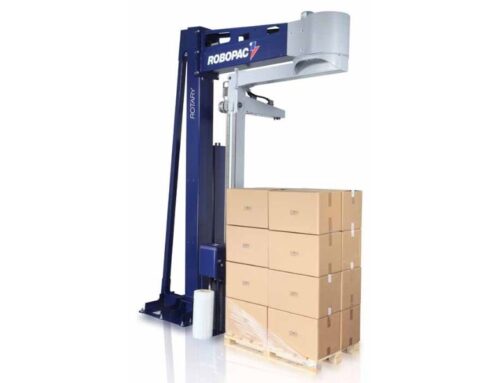
In the agile food and beverage industry, your ability to switch rapidly between products determines your capacity to meet customer orders and respond to market trends. Treating line changeovers as a strategic capability rather than a mechanical nuisance positions your facility for long-term success. By moving from chaotic downtime to a precise, repeatable process enabled by automation, you can unlock hidden capacity in your operation. Contact Robopac USA to discover how our stretch wrappers, case packers, and palletizers can transform your changeover process and improve your line’s performance.