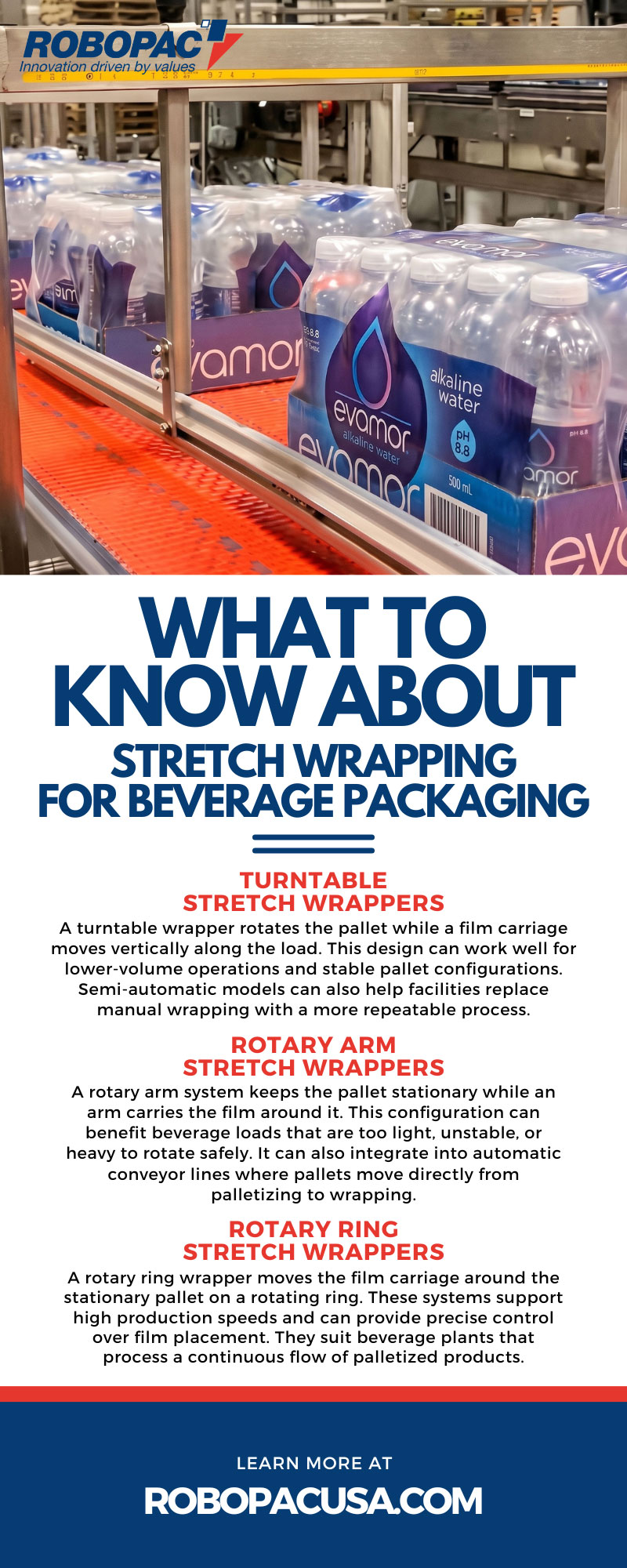
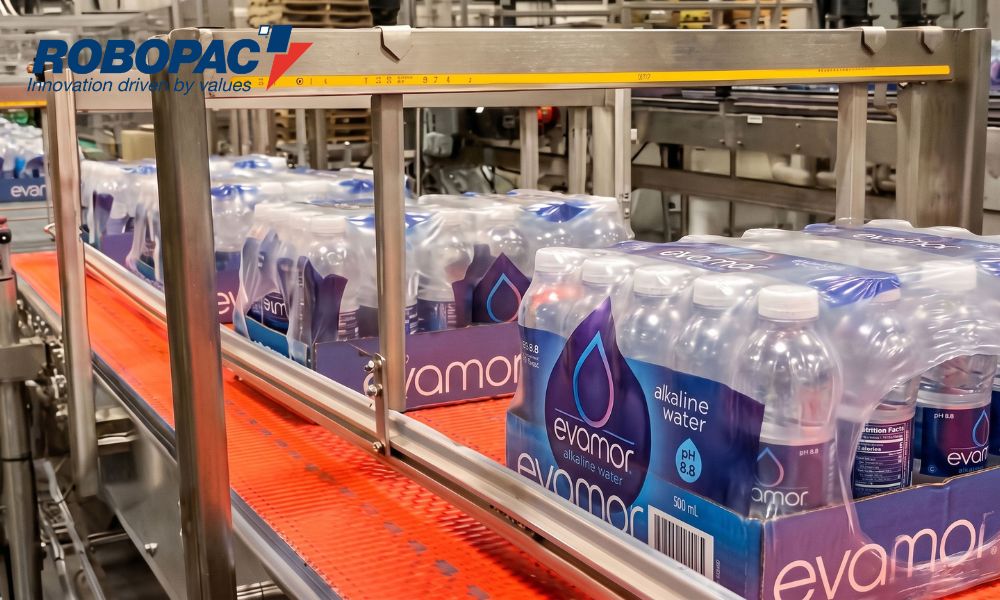
Beverage products move through demanding production and distribution environments. Bottles, cans, cartons, trays, and multipacks must remain stable as conveyors, forklifts, trucks, and warehouse systems move them from one stage to the next. Stretch wrapping helps unite these individual packages into secure pallet loads that can withstand routine handling and transportation.
A successful wrapping process requires more than placing film around a pallet. Below, we explain what to know about stretch wrapping for beverage packaging.
Understanding the Role of Stretch Wrapping
Stretch wrapping applies plastic film around a palletized load to hold the products together. The film creates the containment force that helps resist the movement that acceleration, braking, cornering, vibration, and repeated handling cause. When operators or automated systems apply the film correctly, the load behaves more like a single unit instead of a collection of separate packages.
The wrap also provides a protective barrier against dust, moisture, and minor contact during storage and shipping. However, film does not correct an unstable pallet pattern or damaged secondary packaging. A dependable load starts with consistent palletizing, suitable trays or cases, and wrapping settings designed for the specific product.
Beverage Loads Present Distinct Challenges
Beverage pallets can combine substantial weight with containers that provide limited structural support. Aluminum cans may dent under concentrated pressure, glass bottles can break when loads shift, and lightweight plastic bottles can flex when excessive force compresses the pallet. Trays, shrink bundles, and corrugated cases also respond differently to film tension.
Production conditions add another layer of complexity. High-speed beverage lines need wrapping systems that keep pace without creating a bottleneck at the end of the line. The equipment must deliver repeatable film application while accommodating changes in package size, pallet height, load pattern, and production volume.
Why Load Containment Matters
Reliable packaging equipment for the beverage industry must create enough containment force to secure the load without crushing, distorting, or damaging the primary packages. Containment force refers to the holding pressure the stretched film applies to the pallet. The correct amount depends on the load’s weight, shape, stability, and packaging materials.
Too little containment force allows products to shift during transportation. Too much force can deform trays, compress corners, damage labels, or place unnecessary stress on bottles and cans. Consistent wrapping depends on balancing film tension, pre-stretch, wrap pattern, film layers, and load characteristics.
Choosing the Right Type of Stretch Wrapper
An important thing to know about stretch wrapping for beverage packaging is that not all stretch wrappers are the same. The correct machine design depends on production speed, available floor space, load stability, and the level of automation required.
Selecting a machine only for its maximum rated speed can cause poor results. Manufacturers should also consider the range of load sizes, upstream palletizer output, conveyor layout, film change requirements, safety features, and expected production changes.
Turntable Stretch Wrappers
A turntable wrapper rotates the pallet while a film carriage moves vertically along the load. This design can work well for lower-volume operations and stable pallet configurations. Semi-automatic models can also help facilities replace manual wrapping with a more repeatable process.
Because the pallet rotates, operators should evaluate how the load responds to movement. Tall, lightweight, irregular, or loosely stacked beverage loads may shift while the turntable accelerates or stops. Proper speed controls, load positioning, and wrap settings can reduce this risk.
Rotary Arm Stretch Wrappers
A rotary arm system keeps the pallet stationary while an arm carries the film around it. This configuration can benefit beverage loads that are too light, unstable, or heavy to rotate safely. It can also integrate into automatic conveyor lines where pallets move directly from palletizing to wrapping.
The stationary load helps protect unstable products from rotational force. Rotary arm systems can handle a broad range of pallet weights because the machine does not need to spin the load.
Rotary Ring Stretch Wrappers
A rotary ring wrapper moves the film carriage around the stationary pallet on a rotating ring. These systems support high production speeds and can provide precise control over film placement. They suit beverage plants that process a continuous flow of palletized products.
High-speed equipment must coordinate closely with conveyors, palletizers, safety systems, and downstream material handling. A properly integrated ring wrapper can reduce waiting time between stages and maintain consistent output.
Matching Film Application to the Load
Stretch film selection affects containment, puncture resistance, film consumption, and package protection. Film gauge, formulation, width, and stretch capability should match the machine and load. A film that performs well on uniform corrugated cases may not provide the same results on sharp tray corners or irregular multipacks.
Manufacturers should test film under actual operating conditions instead of relying only on specifications. Trials can reveal how the material responds to pre-stretch, tension, load edges, temperature, and transportation stress. The selected film should maintain containment without frequent breaks or excessive material use.
Protecting Lightweight and Unstable Beverage Loads
Lightweight containers can reduce the amount of structural support within a pallet load. Thin plastic bottles may flex, trays may bend, and shrink-bundled products may shift when film tension varies. Wrapping these loads requires accurate control rather than maximum force.
A stationary-load system can reduce movement during the wrapping cycle, while adjustable film delivery can limit pressure on vulnerable areas. Operators may also use targeted reinforcement to stabilize the load without placing excessive force across its entire height.
Managing Condensation and Cold Conditions
Chilled beverages can create condensation as products move between temperature-controlled and ambient environments. Moisture may reduce friction between packages, weaken corrugated materials, and make pallet surfaces slippery. These conditions can increase the likelihood of load movement.
Film selection and application should account for airflow, moisture, storage duration, and temperature changes. Perforated or ventilated film may support airflow for certain applications, but the material must still deliver sufficient containment.
Integrating Stretch Wrapping into the Packaging Line
Stretch wrapping should operate as part of an end-of-line system. Palletizers, conveyors, wrappers, labelers, top-sheet applicators, and material handling equipment must exchange pallets without delays or misalignment. Poor coordination between these stages can reduce the value of high-speed machinery.
Controls and sensors help manage pallet spacing, identify load dimensions, select recipes, and confirm that each wrapping cycle finishes correctly. Data collection can also help teams identify film breaks, recurring faults, production interruptions, and changes in material use.
Automation Improves Repeatability
Manual wrapping depends heavily on operator technique. Walking speed, film tension, overlap, and the number of revolutions can vary from pallet to pallet. These differences can create inconsistent containment and make film consumption difficult to control.
Automated equipment applies programmed settings to each load and reduces physical demands on employees. It can also increase throughput by allowing operators to focus on material supply, quality checks, and other production responsibilities. The level of automation should reflect pallet volume, labor availability, product variation, and line speed.
Build a More Reliable Beverage Packaging Process
Effective stretch wrapping combines stable palletizing, suitable film, accurate machine settings, and equipment that matches production demands. Beverage manufacturers should evaluate the entire load and distribution process rather than focusing on a single component.
Robopac USA provides configurable stretch wrapping and end-of-line packaging solutions to support consistent containment, high throughput, and reliable product handling. Contact Robopac USA to discuss your beverage packaging requirements and request a solution for your operation.